Saturday, April 12, 2014

Ventura County Agriculture Museum Visit


Ventura County Agriculture Museum Visit

         I have always had a desire to learn the history about where I live.  Temporarily uprooting from Maryland where I have been since 1977 - now retired, I began this journey by visiting Ventura Agriculture Museum on March 29, 2014 as part of my unyielding curiosity about life.  The sweeping panorama view of green field along the Highway 101 VISTA ride on my weekend escapade and the farm workers in the strawberry field at Oxnard Valley off Rose Avenue where I drove by on weekly COSTCO errand pushed the trigger for this visit.   In a sense, I must know Ventura today by looking back how it has been before.
Ventura County Agriculture Museum - The Red Mill
         Ventura County has 10 incorporated cities – Camarillo, Fillmore, Moorpark, Ojai, Oxnard, Port Hueneme, Santa Paula, Simi Valley, Thousand Oaks and city of Ventura.  It’s 60 miles north of Los Angeles and considers being a part of Greater Los Angeles Area.  I have visited or passed by some of them except Moorpark, Ojai and Simi Valley.  All the towns are very similar to what we called in Maryland as part of Greater Washington area.  I found it a bit inconvenient to land at Los Angeles Airport (LAX) every time when I visit.  It took me about 3+ hours with the shuttle at one time from LAX to Ventura.  The notorious traffic on its busy Highways may eclipse the best weather among U.S. cities.   You either love it or hate it.  I am just trying to enjoy it while I can.

The Mill

The Museum Entrance
Santa Paula Train Station with the approaching train 
         The Museum, a.k.a. The Mill is the old red wooden warehouse, located at 926 Railroad Avenue in downtown Santa Paula, next to the railroad tracks and across from the Train Depot.  It’s a stone’s throw away from the bus stop – Santa Paula’s City Hall.  It was built in 1888 to house many of the railroad operations and equipment.  It’s now the official Ventura County Agriculture Museum filled with many antique and rustic farm memorabilia of yesteryears.
Spring Wagon - A Part of CA & backhoes & pitchforks

Once CA's Leading Producer - Walnut, Apricot, Lemon & Calavo Packing Boxes/Crates 

They had their own cook wagon besides bean threshing operations
there was a kitchen on wheels
         To understand why agriculture is the backbone of America’s economy and the important role Ventura County played, I have to take you back hundreds of years back in history.  The Valley is new territory for me, quite unfamiliar.  The museum provided me, the outsider from east coast, the history with exhibits and document all related in Agriculture from 18th century to the modern days.  The self-guided tour took me about three hours including the video film about “the 4th Generation Farmer, Robert Pfeiler – 1908 – 2002.”  The farmers in the video are rotated monthly.

1.  The First Inhabitants – Chumash Indians – Before 1769


Chumash Bowls & Pestles

Cooking Kettle for Chumash Laborers - Ruins of Mission Aqueduct on the wall
         The area was originally inhabited by the Chumash Native Americans beginning about 7,000 years ago, prior to the arrival of Europeans in California.  I took four shots from Mural #2 on my way to the museum on the 8th St. and Santa Barbara St.  There are nine of them on a number of Santa Paula downtown buildings, brilliantly painted by the nations most accomplished muralists.  I will probably use another field trip to study all of them.   I couldn’t possibly do it in one day.  The murals’ vivid introduction to this multicultural back-story in Ventura County portrays elements of the town’s history.  The people and the economy are so attractive and interesting to me.  It’s just like the millennium time capsule of the unique history through the special genius and talent of individual artists.
Mural #5 - Santa Paula Main St. - late 1800s - See the building & street lamp

Santa Paula Main St now - March 29, 2014

Mural #5 - Santa Paula School Children & teacher - early 1900s
Mural #5 - Detailed Santa Paula Main St. late 1800s

         Look at the incredible details, depicting the first inhabitants in the area; the idyllic scenes of tribe living.  I paid special attention to the mother holding the baby by the creek and a silver-haired grandma look-like with the child on the rock over the hill.  Interesting! Huh?  I am dreaming for the land of utopia.  The local Chumash Indians, or “shell bead people” made a peaceful living hunting, gathering, fishing and trading shell bead money with nearby tribes.  From the document, some scholars have suggested that Chumash population may have declined substantially when the arrivals of Spanish ships in late 18th century, that brought disease to which they had no immunological resistance.
Mural #2 - Chumash - The 1st Inhabitants in Ventura County


Mural #2 - Detailed Chumash NativeAmicans

Mural #2 - Detailed Chumash - 1st Inhabitants in Ventura County 
        

Chumash Grandma with a child on the hill & Mom with the baby by the creek 
2. The Spanish Period, 1769 – 1821

         The Spanish ruled California and built missions expanded to the Ventura River with a prolific garden of fruits, vegetables and herbs.  Thanks to the sunny weather, the fertile soil and with Chumash labor, suited to ranching and farming.  They built water system, a reservoir and a seven-mile aqueduct.  San Buenaventura Mission in downtown Ventura was one of the most prosperous of all the California missions.  The Spanish missionaries also converted native tribes to Christianity and prepare them for life in a Spanish society.  The language, the skills such as brick making and construction, cattle and horse raising and weaving were taught.
San Buenaventura Mission - Downtown Ventura
3. The Mexican Period, 1821 – 1848

         After winning the independence from Spain (1821), Mexicans took over the California Spanish Missions.  It marked as the beginning era of Mexican ruling.  Cattle rancheros, grape vineyard were the major development for open trade during this period.  The 1821 brought not only the Independence, but also the hides and leather trades to Yankee sailors and merchants who were seeking new goods and new markets.  Some of the lands converted from dry-land farming of wheat and citrus into cattle grazing.  Spanish and Chumash Native Indians, who were not assimilated into Mexican culture, were increasingly marginalized and relieved of their land titles.  Gradually, they were drawn into debts and alcohol.

4. The U. S. period, 1853 – current

         California was acquired by the United States under the terms of the 1848 Treaty of Guadalupe Hidalgo following the defeat of Mexico in the Mexican American War.  I have probably seen quite a few spaghetti western movies during my school days without ever knowing the details in history. 

         To early settlers, like the video I watched in Calavo Hall, the 4th generation farmer, Bob Pfeiler of Oxnard, the American West provided ample land for agricultural development from dry-land farming to underground water and solar-powered irrigation during modern time era.  Early farmers, Bob’s grandfather – Louis Pfeiler in 1865 grew crops or raised livestock that were familiar to them, such as wheat, corn, hog and sheep.  Then, his parents, Albert and Lydia in early 1900s found out the dry climate of this region required new, and large-scale farming methods to make a profit.  They began to try the diversity of crops, such as walnuts, apricots, corns, citrus, lima beans and vegetables.  With the swift growth of the farm equipment industry, which, in turn, brought more land under cultivation.  Between 1870 and 1900, the era of American frontier came to a close. 


Harvesting Green Beans - 1965

Harvesting Tomatoes - 1965


Irrigation then - Ventura River
Irrigation now - underground pipe


         The contribution from the homestead citizens, like Bob Pfeiler, during the first two decades of the twentieth century became the golden age of agriculture in California.  

         One of the halls that housed the early agricultural artifacts is Limoneira which grew from its 1893 founding as a Santa Paula-based citrus industry pioneer, producing lemons, avocados, oranges, pistachios, plums, apricots, pluots, a.k.a. dinosaur eggs, and cherries, into one of California’s biggest agribusiness. 

         The second hall – Calavo, started as avocado growers to serve Limoneira’s packinghouse and eventually developed into an international consumer goods and farm products company - served as the education center from the active bee colony - actually produce honeycomb - to plant lima beans and strawberry and lemon picking for students to learn how food is grown in the region and let them climb onboard the antique tractor to appreciate the farmers’ life.  The children’s poems, artwork station at the corner makes it a hands-on-science program for schools.  I wouldn’t be surprised that baby Forest will one day leave his masterpiece right up on the wall. 
These Kansas City Mules & Bolivar came from Missouri
as did some of the employed teamsters to drive them.
They were good combinations.


Hands-on-Science Program
     
         From the exhibit, in 1913, Ventura County farmers were producing three fourths of the world’s lima beans.  I purchased a souvenir bag of “Celebrating The Historic Lima Bean Capital of the World” with the recipes from Margaret Pfeiler Borchard – the descendent from the farmer Bob Pfeiler.  There was a lifelike replica of two mules in the center.  The spacious area with the whitewashed walls and the original hardwood floor was also used as the vintage wedding site.  I happened to take a few pictures of one special event on my way out the museum.  Congratulation!  Lucky couple!


         I am the lucky one as well -  $1.70 round trip VISTA fare and $3.00 admission for seniors.  I absorbed the Ventura agricultural heritage information like the dry sponge on the generosity of farmers like Bob Pfeiler and many volunteers from the museum.  

         On my way home in VISTA bus, Santa Paula’s landscape, the rolling hills and rugged mountain with “SP” carved on the peaks was on my window view.  From sugar beets and lima beans to lemon orchards, avocado ranches, strawberry patches and the “Citrus Capital of the World”,  I am definitely the beneficiary of generations’ hard work from Ventura County local residents, no matter where they are from, Mexicans, Chinese, Filipino and many other immigrants. Today, there’s a profound appreciation in me for having a museum that’s dedicated to telling me the story of the 
agriculture in California.

         I have the feelings for the land.  My father was a hard-working farmer, whose story in Taiwan is forever remembered deep in my heart.  And thanks to California’s tax payers.


Tuesday, April 1, 2014

Farewell visit to Joyce – My College Classmate


Saturday, 3/22/2014

Farewell visit to Joyce – College Classmate

            I decide to bid my farewell to Joyce, my college classmate, class of ’71 at National Cheng Kung University.  After nearly 25 years in Newbury Park, California where her husband, Robert, gave her the fondest memory, she made up her mind – with her never-ending internal conflict – to pack up for Taiwan to retire there temporarily for a couple of years at least.  She has been in a world of despair ever since Robert passed away on February 23, 2012. 
VISTA Highway 101 – The Oaks
            I took VISTA Highway 101/Conejo Connection instead of driving to Newbury Park this time.  I told Joyce, “I will arrive around 11:00 a.m. at The Oaks.  The bus stop should be across from Macy.  We will have a simple lunch with fresh local Oxnard strawberries from Whole Food.  I have the home made desert you like – peanuts with red dates, goji berries and Chinese white wood ears-白木耳.”  With low and soft voice, she responded, ‘be safe! I will be there to pick you up.  I’m in a mess.  I had trouble sleeping last night.  There are so many thing I need to tidy up before I leave next week.”   

            I made it to Ventura Bus Transfer Center- the wacky architecture, with 25 minutes’ walk. I remembered it took me about 17 minutes in January.  Maybe being nervous the first time without knowing the exact location of the bus stop made me walk faster.  The lady with the cute dog and the poster for animal protection was still there across from Target parking lot.  The homeless wanderer who greeted me “good morning” was no longer there.  Instead, there was one, bundling up in layers of clothes sleeping behind the bush of Sears.  I dared not to take the picture as my blog document.  It would be interesting to know his story of why he ended up there as the only option.  My soft side to help others, capable of not, is still in me.
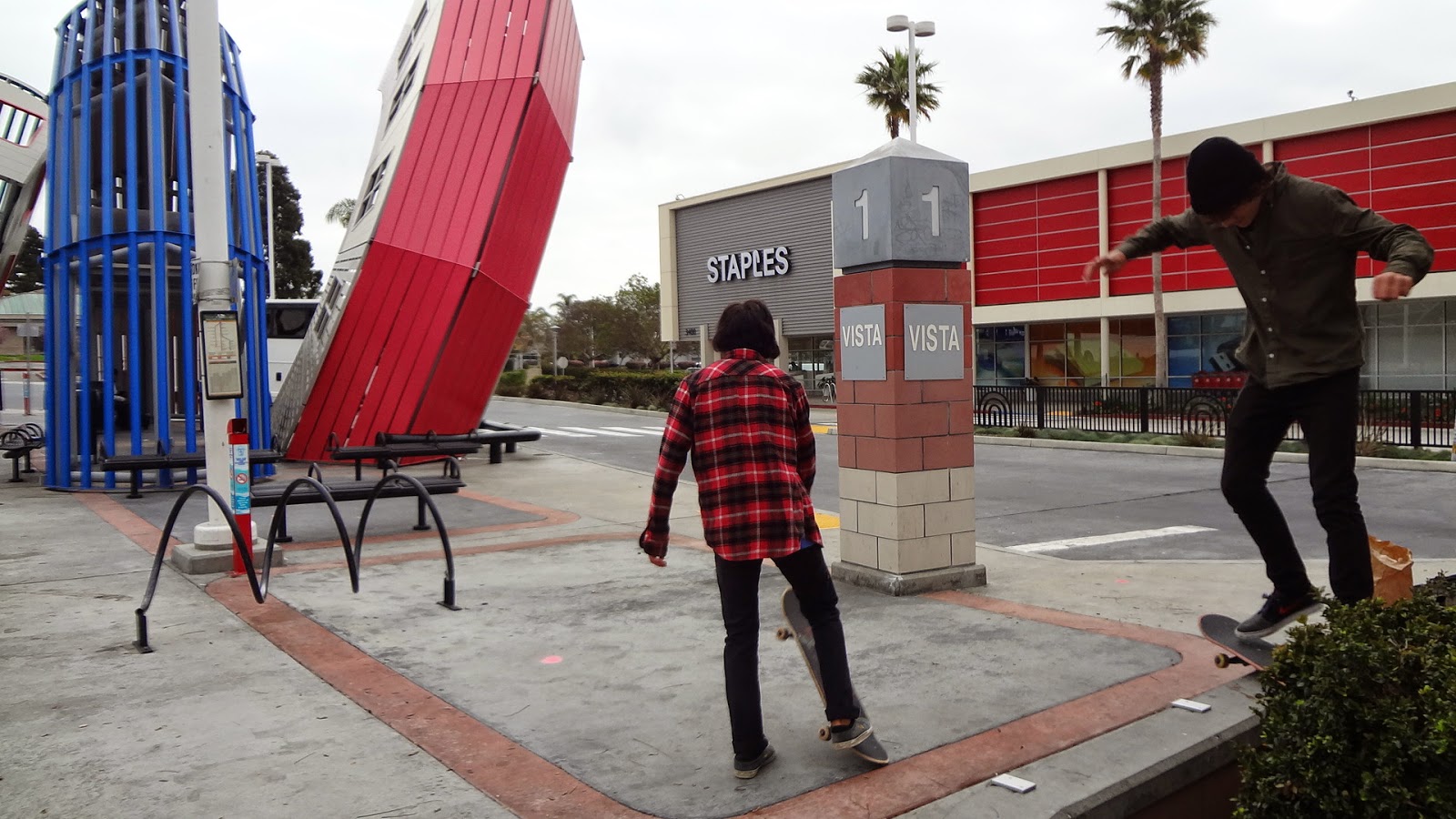
Skateboarders

            A few helmet-less teenagers were performing the daring tricks on the bike loops and seating cement where people seat to wait for the bus.  Thrilling and cool, I wondered if their parents ever told them or themselves knew the risks involved.  I know it’s a trendy and funky looks to show who they are as teenagers, but, at least put some safety equipments to protect your head.  Kido!  Oh, well, I have enough grand parenting to worry about.  If Forest becomes like that, it’s his part of growing up process.  Let them learn the lesson themselves.
Camarillo Outlets
            I noticed the bus loaded more young teenagers with mixed ethnic groups.   However, The Latinos are still the majority.  The bus driver, the Filipino looks with dark skin, friendly called out ‘Thousand Oaks, Camarillo Outlets!”  Now, I realized why there were so many weekend shoppers on this bus.  This route doesn’t run on Sundays. 
Oxnard Plain            

It still amazed me to see the expansive view of the lush green valley extended as far as I could see to the foothills.  I gasped the first time when I saw the big machines operated by farm workers, and portable toilets dotted in the green fields on both side of Highway 101.  I did not take for granted in seeing the beauty of the nature.  My mind popped out the questions - can the machine pick the strawberries?  There must be hard laborers who harvested the bright red and luscious strawberries I brought to Joyce’s today. 
Arrival of spring

            I have not sensed the arrival of spring until my son-in-law purchased the seedlings for the backyard garden this week.  To me, southern California has always been warm and sunny since I got here.  All of sudden, I did see the mountain hills turn a bit green, some of the trees and shrubs, if not having leaves or flowers before my arrival, did put out new foliage.  It’s nice to see the un-noticeable changes from the field trip.  I have been confined to a sheltered environment. Lucky me!  The manicured gardens with all kinds of blooming flowers in the nice neighborhood can fool me with the changing seasons.  
Strawberry Pickers
            I found the answers when I saw rows and rows of workers bent and stooped their backs in the fields.  It’s not only one ranch, it’s several of them passing from my window view.  But, it’s only a glimpse.  I could not see them up close.  One of the zoom-in pictures showed.  Who are all these farm workers?  Are they migrants or local residents? And where are they from?  The bus ran fast past along acres and acres of green land with only visible dots lined up in furrows of strawberry beds.  John Steinbeck’s book/movie – The Grapes of Wrath I read and watched Henry Fonda as “Tom Joad,” during my school years, detailing the bleak lives of migrant workers in search for opportunities and work in California still haunted my thoughts years later.  In the distance, many ranches had red colors edging out of the plastic covers if I looked closely.  Since it’s spring, the peak season of Strawberry, some of the fields had already re-plowed to totally flat brown dirt for rotating different crops - I believe.  I will use another field trip to visit Ventura Agriculture Museum in Santa Paula.   Being a temporary local now, I should know better that Oxnard is America’s agriculture center of strawberry.


Cesar Chavez Drive - Oxnard     
      
            I took Rose Avenue every Saturday to do my weekend grocery chores.  Cesar Chavez Drive is there to remind me of the icon figure, Cesar Chavez, who became best known as Latino American civil rights activist.  I had remembered that Jane Fonda, the anti-war activist, spoke at a rally with him, the founder of the United States Union Farm Workers in 1970s.  I also heard about it in the news that President Obama proclaimed March 31 as Cesar Chavez Day. He was born in Arizona on March 31,1927.  It’s an official state holiday in California.   The Oxnard Historic Farm Park and Museum sign is visible when I drive by weekly.  But, I never find the time to learn how important Oxnard’s fertile Plain played in American agriculture.  Shame one me!  I will definitely do it one day.   He, as a local Oxnard labor must have made a historical impact organized the striking California grape pickers, mostly Latinos and Filipinos, on a 340 miles march by foot to California’s capital.  The newspaper Ventura Star reported the town will have series of marches in Oxnard about half mile as a symbolic gesture to honor his would have been 85th birthday, as well as the 50thanniversary of the United Farm Workers that he co- founded.  
Joyce – My Classmate
            Class of ’71 Foreign Language and Literature Department, National Cheng Kung University is a very unique mixture of students from everywhere in Taiwan.   Despite the fact that the University is often considered to be among the most prestigious universities in Taiwan.  The students, rich or poor, commuters or live on/off campus were mostly intellectually engaged and wanted to get the most out of the college for a better life.   The cutthroat college entrance examination was as competitive and stressful as you could imagine.  Joyce, the outstanding senior from the Provincial Tainan Girls’ Senior High School ranked the first with the highest examination scores among our class.  At that time, the commuter students, especially the folks from Tainan tended to be less likely to mingle with other students who lived in the dorms.  It would be stereotypical without looking into the facts of their commuting time and family commitments. But, traditionally Tainan is considered to be more conservative, culture wise, than the folks from other cities.  Joyce, the commuter student and I, the live-in-dorm student were set apart because of this reason.  It’s not until the senior years, she and I hung out at my best friend, Gloria’s off-campus residence at University Road.   We sat back after the whole day class or after her noontime napping to discuss about the future life planning after graduation.  I got to know her more than the rest of the live-in-campus students in our class.   
The 1st Chapter – Life in Taiwan
            She stayed on in Tainan, her hometown, with her mother after graduation – Taught English in Middle school for 15 years, married and the son, Jeff was born.  He is 40-year-old now. I was introduced to meet him during one of my visit in 2013.  After graduation, we have all lost the contact since then.  Just like all my classmates spread out everywhere to chase the professional goals without any context to keep in touch.  I was led to believe that the journey of that part of her life was something she would like to keep herself.  
The 2nd Chapter – Life in America
            In 2007, when Judy and I initiated the project of Class Album I, 《外文內美 - 第一集 our mission was to re-connect all 48 classmates from ’71 Foreign Language and Literature Department at National Cheng Kung University.  Painstakingly, through e-mails, phone calls, we were able to track 37 of them.  There was one who was unfortunate to be listed as ‘diseased’; and the rest of 10 were at the columns of MIA – Missing in Action.  I was surprised that Joyce was one of them. Thanks to the world alumni connection, in 2008, I was able to get hold of her.   Ben and I attended National Cheng Kung University’s Carnival, World Class Reunion event in Pacific Palms Resort, Los Angeles.  Joyce re-appeared with her beloved husband, Robert Culvert, 78-year-old at the lobby to greet Ben and me.  This was 37 years after our graduation.  We have been transformed from sweet and demure ladies into golden girls with empty nests.  I based my home in Maryland while Joyce, as an audiologist from her master degree in Brigham Young University,Utah, staying in Newbury Park, still working at her Husband’s ‘Hearing Aid’ company. From then on, I have always kept close contact with her when I had the opportunity to visit my daughter in Ventura.  The distance is actually not far – 20 miles.   The love story- impressive and touching, she shared with me ‘a dedicated and devoted employee and an appreciative boss, and loving husband’ was her 2nd chapter - life in America.
Joyce’s Husband – Robert Culvert
            Look at the pictures taken on the Memorial weekend in 2011.  Robert, 80-year-old, was such a humorous guy.  I teased him for his James Coburn’s look and height.  Joyce is also a rare breed of close to 6 feet in height.  When he found out that my son, Eric works for MITRE in air safety control division; he shared with us his fearless act of flying airplane in the flight school in 1972.  He flew into President Nixon’s “Western White House” air space without knowing he had violated the air traffic rules.  We, Eric especially, all got a kick out of his fun jokes and adventurous nature of personality when he was young.    
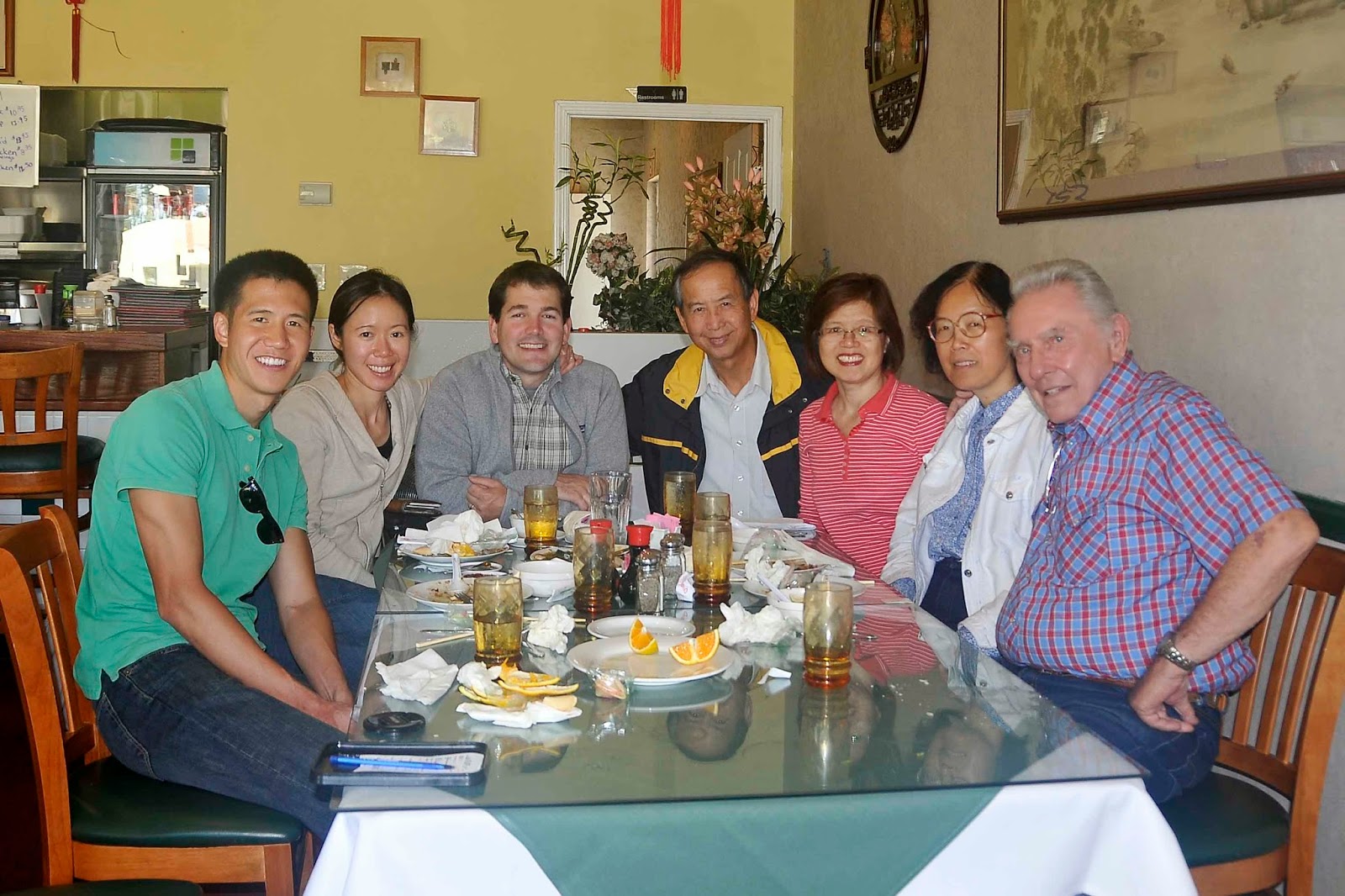
            When Robert passed away, pumping iron in the gym and knocking the head on the floor, Joyce was tending her hospitalized mother in Taiwan.  Rushing back home in Newbury Park and taking care of Robert’s funeral proved to be sapping her strength physically and mentally.  To cope with the grief and loss, she prayed, played the hymns on the piano and talked to Robert a lot afterwards.  

Generation Gap
            My retirement in January 2014 from Montgomery County Government started my journey to temporarily settle in Ventura California as a grandmother.  Joyce happened to play the same role with different degree of grand parenting to her son.  Jeff, a newly wed last year in Taiwan, had a healthy boy 2 month younger than my grandson.  Joyce was excited to be a grandmother wanting to be helpful.  My situation with my daughter’s family and grandbaby Forest prompted a lot of discussion between us.  We both were trapped in the unavoidable conflict of giving the unconditional love to our children and also being rejected or neglected by the children unintentionally.  Time and time, we both reminiscenced about our good old days in the campus and shared how our parents instilled us the traditional value of Confucius’s filial piety doctrine.  At the end, we both empty nesters, could only blame us for expecting too much than they should.  There is really no one’s fault.   We both posed at the Chinese restaurant as the lone customer in November, 2013. The relunctant smile was forced after a good cry.
    
Home Bound to Heal
            She took me to her Mormon church where she and Robert belong to one week when I visited her.  I dozed off in the middle of a long confession service.  On the way out in the parking lot, we both encouraged each other to try to comprehend that our children are now independent human beings and not the hapless creatures, who depend on us entirely a long time ago.  It’s time for her to heal both physical and mental strength. 
            As I reflected our talks during many gatherings since I got here.  The whole journey of our life begins to unfold.  Taiwan is a beautiful place where our roots are.  She wanted to go there to be surrounded with the familiar voices and faces.  Eventually, the end of her exploration will be to arrive where she started.  No matter how the world changes according to the way people see it.  She wanted to see the place again.
            At lunch, I cooked the chicken with lettuce from Oxnard, California.  The sweet and plump strawberry was scrumptious.  Joyce loved my desert with her favorite goji berries.  There was no celebrating; instead there was intense sadness in me when Joyce bowed her head to pray before lunch. 
Closure
            I found myself as well.  At the end of every road I took I meet myself.  

            I asked Joyce to pose a few pictures for my blog to her.  She chose the backyard hyacinth Robert planted.    

            This Journal is for Joyce and it happens to be the Cesar Chavez Day to honor him in California.


Saturday, March 22, 2014

Forest's First Fall - Humpty Dumpty Had a Great Fall


Thursday, 3/20/2014

Forest’ First Fall

            Humpty Dumpty sat on a wall,
         Humpty Dumpty had a great fall;
         All the king's horses and all the king's men
         Couldn't put Humpty together again.

            6:25 a.m. Baby Forest fell off the rocker chair – unbuckled and bumped his head.

            The rhymes are from Celeste and Eric ‘s old Mother Goose book I brought along in January.  Grandma has always been reading to him after feeding to keep him calm and quiet.  

            It has been a perfectly controlled morning routines ever since I took the job as Forest’s “Super Nanny” in January.  I followed their instructions instead of using my own as “Super Nanny” per se.  He is a remarkable good sleeper through the night from 7:00 p.m.  everyday.   I joked to my daughter, “He is all programmed with a set of scientific codes.”  His peeping would start around 5:30 a.m.  I could hear him scratching the sheet and soft landing roll back to sleep.  Then, sweet babbling or humming sounds like those of a baby bird; cheep, cheep, buzz, buzz, mum, mum …. would go on and off pending on his mood.   This morning his peeping changed to high-pitched loud crying message, “Hey, you all, I want to get up!”

            So, it happened when Hans was readying himself in the shower for early meeting in Santa Barbara, and mom was making 4 bottles of milk of the day.  Instead of asking me for extra hand, she could have done.  She knew I was up 4:00 a.m. in the morning usually.  Instead, Celeste moved him from the crib to the kitchen settling him on the rocker chair unbuckled.  That was one of the grandma old-fashioned rules – never left the child unattended or unbuckled I had mentioned to them when I took the job.  Yes, she heard it, but actually doing it is another. 

            When I heard ‘Bam’ the hard-hit on the floor, I rushed to his nursery room. Not here! Then, I checked in the kitchen, Mom, feeling so distressed, already held him rocking in her arm.  The baby was crying hysterically, and huffing and puffing incessantly.  Poor thing, it must be terrifying to him for the first fall.  I remained silent and quickly put the blue ice wrapped with clothes trying to ice the little bump on his forehead.   With him squirming around, I had only little success.  By then, Hans already came out of the bathroom and assessed the condition.  Luckily, it was only a little red and swollen – no big deal!  I am sure both of them felt awful for what had happened.  It’s their first child as new parents.  Celeste was distraught especially.  Upset is an understatement.  I assured them that I would keep an eye on him all day and would try any tricks to ice his forehead.    

            Hans instructed me to double check his behavior before he left.  Celeste and I again quietly sat on the couch – no comments for anything.  When Forest started getting back to his normal hi-energy bouncy movement on his mom’s lap, I know he was going to be ok.

            To break the awkward silence, I started to recite the nursery to myself instead, or maybe to Forest particularly.

         Humpty Dumpty sat on a wall,
         Humpty Dumpty had a great fall;
         All the king's horses and all the king's men
         And Grandma will put you back together again.

            It’s that moment that I shared with my daughter my parenting experience again, which she has been quite open with me about hers.  That’s good.  But I started,  “My morning-madness routine like the one I could remember for your brother, Eric– picking him up from the crib with blanket wrapped around, rushing for his readiness to the baby sitter’s house.  Sometimes, he was fed and sometimes he was not, because I had to get you ready for morning day-care program as well.  With your daddy being out of town all the time, I wished for an extra helper.  But, I made it without, or maybe, I didn’t have the luxury to do so.  I ended it up being guilty for my life as the worst mom in the world.  Eric’s many accidents – from 8 months to 1 year old, two trips to The Shady Grove Hospital emergency room for a few stitches from bumping to Daddy’s desk and hitting the fireplace bricks from crawling.   The worst was his swallowing 1 dime and 1 nickel when you were counting your lunch money and he got his hands before I could stop him.  He was 1 ½ years old then.  So, do not feel bad.  There will have several bumps, cuts and scratches, as he gets older.  Your brother is the example.”  Then, she started crying, perhaps from postpartum blues still?  “I know I heard you when you told me, but, I just do not want to be lectured.”  I started to have watery eyes also.

            As the blue ice in the wrapped clothes started to melt, I felt like the strained relationship between mother and daughter begins to loosen as well.  It’s just a comforting closeness of tight-knit relationship.  I will never use my authoritative style of parenting to my grandchild, because he is not my child.  I do not think my daughter needs my affirmation of the love I used to feel for her anymore.  She said, “Mom, I am a grownup now!”

            We all believe in that we both are not merely competitive and quite independent in nature, we also differ as to how best to offer our parenting to raise the child.  Now, we are expected to put aside our differences and support a common goal – easy! 

            Ugh, It will never be a perfect world.  We will mend the bruises either for Forest or for us; it’s just a part of growing pains of our lives.


Thursday, March 20, 2014

Let's Have a Beach Walk - Trick


Saturday, 3/15/2014 
           
A Clever Trick

            My son-in-law, Hans, treated me lunch at one of the best Mexican restaurants in Santa Barbara on Saturday.  He knows I would normally prefer solo trip to explore the area on the weekend, and I am not a fan of Mexican food.    He tried to trick me first. He said, “Let’s go out for a weekend walk at the beach.  It’s sunny today.”  He started the car toward Santa Barbara direction where VISTA bus took me in February.  Somewhere along the pretty neighborhood, he got the baby settled and said, ‘Come on, you have been travelling like the local now, you’ve got to try a little further, Eat like a Local.”  

La Playa Azul Café

            The Mexican restaurant “La Playa Azul Cafe” is located at 914 Santa Barbara Street.  It was tugged in the neighborhood with tree-lined streets.  The houses, all red-tiled roofs and white stucco walls, were beautifully built on the gently slopping hills.  There were even more luxurious villas perched on the mountain overlooking the blue and wide beaches.  The sidewalk stretched before us after we parked our car under the eucalyptus tree.  You wouldn’t have known it’s a restaurant if the colorful umbrellas were not open in the patio.  It’s just nicely blended with the surrounding exclusive residential areas.   The only thing I noticed was the steady pulse of traffic on Laguna Street not very far from here.  Hans said, ‘this is a quieter area comparing to bustling downtown Santa Barbara with assortment of diners, coffeehouses and nightclubs.”  I knew what he was talking about now.  VISTA solo trip in February does help.

   
            Inside the restaurant, it’s full of Mexican culture.  Pictures with bright and bold colors using the tones of reds, blues, greens and yellow were hung on the wall.  The rich red tile floors and the big vases of fresh lilies, orange, red and yellow and palm leaves are typical of Mexican decorations.  I saw Mexican sombreros – the national symbol displayed on the chalked menu atop at the counter.  Since it’s a family-run café, the customers lined up for ordering instead of being seated by the uniformed waiters.  I didn’t see any waitresses.  There were many specials of the day.   I chose Pescado in Salsa Verde because I recognized the word halibut, which is a flounder.  Both Celeste and Hans ordered chicken burritos.  For baby Forest, mom made the puree carrot, of course, organic, for his first eating out.

 
            To make out the details of the dish description was challenging.  It’s simply halibut in tomatillo salsa.  The fresh fish sautéed with olive oil, garlic, onion, cilantro, green olives and marinated capers.   Hans, who I considered a global trotter from Patagonia managing non-profit international conservation organization, made effort to teach me a few Spanish words.  For examples, playa – beach, Azul – blue, pescado – fish, salsa – spicy tomato sauce, verde – green.

Story Sharing

            We shared the interesting stories of how Forest was tightly swaddled during his first three months in Velcro sleep sack.  He is all liberated with different sleep sack now. 
  
            I was mostly relaxed enjoying their treat.  When I made the decision to retire and come to California as a unpaid Super Nanny in January, I traded my favorite Chinese restaurants specialized the home-made cuisines in Montgomery County, Maryland for a modified American Chinese home cooking catered to their tastes, which was significantly different.  Hans’ mother, my mother-in-law, teased me as the “private chef flew in from Maryland.” 

            I could not find any Chinese grocery stores in Ventura area.  I managed to find one, Island Pacific Seafood Market, 20 miles away.  But, it’s mainly for Philippine items.  I told them the frugal graduate student’s life back in Blacksburg, Virginia in 1973; “Daddy and I used to grow bean sprouts out of green beans in milk carton, make soymilk from dried soy beans and tofu from the soymilk adding the ‘Plaster of Paris’.” Celeste’s eyes grew wide from the complete surprise when I mentioned the name.  I said, “it’s not what you use for walls or your cast when you break your arm! It’s the white edible powder to harden the liquid, just like gelatin.” “It’s the ingredient I smuggled in by tucking away in my textbooks along with other necessities in the luggage to start my new journey in America.  My senior friends in college already warned us, ‘you can’t find tofu in America, be prepared.’”
 
Assimilation

            As we continued on, four of us were soaking up the bright sun while enjoying the pleasant taste of Mexican food in Santa Barbara.  I was relieved that my anxiety of being alienated and feelings of missing home suddenly disappeared.  I know I have grown out of all the difficulties in assimilating the new culture for the past 40 years.  Eating Mexican food in southern California where the Latinos are the majority is probably the easiest part besides the language, and walks the fine line in their boundaries.  I am learning its history and customs along with both their temperament and personality as I go.  It’s just like Forest’s adapting to a brand new environment.    However, assimilation takes time, and it’s really an ongoing process that can take the better part of my short stay here to achieve.  It’s simply doesn’t happen at all once.  

            We didn’t go to the crowded beach walk, because Forest was getting fussy from the hot temperature, it’s close to 90 degree.  These days, we all revolve around him as the center of gravity.  The folks in east coast will be expecting another round of snow on Sunday. 

            I am here in a beautiful setting, surrounded with family blessings, great atmosphere and trying out the local food in southern California.

P.S. – I did not bring camera.  These pictures are from the restaurant’s commercial advertisements.


Saturday, March 15, 2014

Field Trip #5 – The City of Santa Paula’s California Oil Museum


Saturday, 3/8/2014

Field Trip #5 – The City of Santa Paula’s California Oil Museum   

Prologue

            Driving down Highway 101 on my weekly trip doing errands, from Thousand Oaks to Ventura, it’s a pretty scene with the seemingly endless fields of strawberries, onions, broccoli, and lettuce.  On the distant horizon, a few oil rigs with hammer nose up and down motion was barely visible when you drive 70+ miles speed on California Highway.  But, there are there, interspersed with the crops on the rich agricultural land surround by the rolling hills and rugged mountains.  It’s simply an odd incongruous note to the scenery.


            I decided to do what the locals do – learning the city history – Oil Dig in Santa Paula around 1888.  I packed up with my camera; writing pad and lunch, off I went to visit “The City of Santa Paula’s California Oil Museum.”


VISTA –Highway 126

            The comfortable bus run by Ventura Intercity Service Transit Authority or VISTA Highway 126 Eastbound, took me to Santa Paula City Hall bus stop, 12 miles in 30 minutes - $.85 Medicare Card fare.  The bus driver, a young lady, with Hispanic accent kindly told me, “just walk one block, you’ll see the old red brick building.   That’s the one.” when I asked her where I wanted to go.   

Santa Paula City Hall

            I crossed the park across the City Hall, where small groups of Hispanic seniors gathered together socializing.  I paused a little trying to take some pictures, but decided against it.  It’s a warm afternoon.  I felt a bit awkward walking past them to disturb their nice gathering.   


The California Oil Museum

            The oil Museum is located on 1001 E. Main Street, Santa Paula. 

The Ground Floor Exhibits

            The docent of the museum, Mr. Will Richard from local Santa Paula, about 70-year-old, who nicely greeted me.  He gave me a copy of floor map and explained to me that he would conduct the museum tour in one hour after my self-guided tour on the ground floor with all the permanent exhibits.  I saw the oil and gas industry equipments, heavy- duty iron and wood operating drilling rigs, product containers, and historic vintage gas pumps –Texaco, Richfield, Conoco, Shell and Red Crown - I only recognized a few logos.   I had no idea that Santa Paula had such Oil History.  So, I kept him within my sight lest browsing through the display rooms lead me lost.


            I jotted down the questions I would like to ask him later.  Since Santa Paula is a small town and the museum is an intimate size.  I was able to take time to study the history of the black gold found in 1888 in Santa Paula.  I joined about 10 visitors, all men and one young couple; all with their comfortable shorts for Sunny California weather to start with Mr. Richards’ guided tour upstairs.
 
            The Santa Paula Historical Society run by Mary Alice Orcutt is the descent of William W. Orcutt, one of the three pioneers who played a major role in Union Oil’s geology and exploration in Santa Paula.  The organization is responsible for training all the docents.


The Union Oil Company Office - Upstairs

            Mr. Richards guided us through a different entrance that lead to upstairs where the Union Oil Company office was housed.  Based on the dingy yellow photos preserved, he informed us that Santa Paula is the birthplace of the Union Oil Company on October 17, 1890 after the oil was discovered.  The building was originally the Santa Paula Hardware and Post Office on the ground level.  The upstairs where we stood was the Union Oil Company’s office.  The building was restored to its original appearance in 1990 for the Centennial Celebration.  It was designated as the history landmark of Ventura County.

         The pictures of black crude oil gushing out of the ground reminded me of the movie “Giant” that James Dean, Rock Hudson and Elizabeth Taylor were on.  That was quite a powerful image when James Dean found the black oil gushing out at Rocks Hudson’s Texas ranch.  Of course, the geographical location in California and Texas is different, but, America the bountiful with the abundance of land and natural resources, many early explorers of America found the black gold in their territories almost around the same time.  


Three Heroes of California Oil Digs

            These were the three heroes who lead the formation of the company.   


            1. Lyman Stewart (1840–1923) was born in northern Pennsylvania where the first successful oil wells –Titusville was drilled in 1859.  He had two disastrous attempts in the same areas.  He eventually was introduced to Wallace Hardison, a relative of his friends and the 2nd hero of this museum.  With the pioneering spirit and business acumen between them, they purchased some land in this region.  The joint venture ‘Hardison and Stewart Oil Company’ took off and was moderately successful.  Both of them sold their interest to Standard Oil, which was founded by John D Rockefeller, the wealthiest man in the world.
            2. Wallace Hardison (1850-1909) was born in Main.  He followed his brother to Pennsylvania trying to find some work in the oil field, but eventually befriended with Lyman Stewart.  The successful story ended in Santa Paula, California.
            3. William W. Orcutt (1869-1942) was born in Minnesota, but grew up in Santa Paula where as a youth he sometimes worked at odd jobs at the Union Oil refinery before Stanford University to study engineering and geology.  He used the scientific knowledge to explore the petroleum technology.  From his desk, I saw his original notes and early works in Geology measurement for rocks and terrain.  He eventually became Union Oil’s chief geologist, land department manager, superintendent and vice president of Union Oil Company. The pictures showed his calculated math formula and Stanford track team certificate in 1895.


La Brea Tar Pit Discovery - William W. Orcutt

            Mr. Richards recommends that we should visit La Brea Tar Pits in Los Angeles.  William W. Orcutt, known as the “Dean of Petroleum Geologist,” discovered fossils embedded in the black asphalt deposit.  He was the one with the study in paleontology, which brought this Pits to the attention of the scientific community in US.   

Historical Records and Penmanship

            Look at the big books displayed.  It recorded different oil pits, fields, and number of barrels dug out per day.  Mr. Richards pointed out the beautiful penmanship on the journal and accounting ledger books.  It indicated the importance of note taking and communication before the advent of typewriters or computers.


            I saw the superintendent’s living quarter, which reminds me of the TV series “The Walton’s” – simple, plain and no luxury.  It’s next to the office where the superintendent worked day and night.  It’s the era of black gold rushes.  The spouse from the superintendent did complain the lonely life of a workaholic husband.   True or not, it’s just the offhand comment from the docent.


Afterword

            I walked out of the building feeling loaded.  Before the trip, I do not know in details how they get the oil out of the ground and how they make gasoline for cars.  Now, I do.  It’s not just fascinating to really seeing the original artifacts in person, but it’s also stimulating to imagine this part of land where the pre-historic mammals used to roam.

            It’s definitely well worth the visit with $3.00 senior rate.   I was also lucky to have a guide who is full of interesting knowledge.  I will make it to LA museum one day, maybe with my grandson. 

            P.s. this journal was delayed due to my allergy episode past week.  My back is not cooperating either.  Baby Forest, over 6-month old and a ball of energy, is wearing me out. 


1                              Santa Paula, The Citrus Capital of the World – on the way home from the museum.


Friday, March 7, 2014

Camarillo Library Visit - Accidental Discovery


Sunday, 3/2/2014

            I finished the last of five pre-requisite “Volunteer Tutor Training in CA” last Saturday, 2/22/2014.  All of 15 tutors were officially certified to tutor in any county in California.  We will be called when the tutors and learners, 18 or older are screened, tested and matched.  One of the assignments we were given is an alternative “The Laubach Way” to reach out the needed adults in Ventura County only.  Originally, I opted out the program due to the distance, which I need to drive to Camarillo Library, about 15 miles south of Ventura.  Then, Carol Chapman, the program Director, recommended me to pay a visit if I can.   It turned out to be a worthwhile visit for me.
           
            It’s been raining this week since Tuesday night, and all day on Thursday, Friday and Saturday.  It came as a welcome break in California relentless dry weather.   Folks in east coast blamed the rain in California bringing the “Winter Storm Titan” ice and snow in Maryland.  I thought the winter in east coast should start out with the quaint holidays – turkey, chocolates, Christmas candies etc.  But, it ended as a yearly reminder that the Greek god didn’t care if it’s March, and spring is only weeks away.  No matter what, it surely dampens my adventurous spirit.  My mind is getting moldy.   I can’t go sightseeing this week.  There is nothing better than going to the library on a rainy day. 

            I left for Camarillo Library around 10:30 a.m.  It’s a beautiful library with California Mission tiles roof.  There is a picturesque fountain courtyard in a setting surround the mountains now all fogged up because of the rain. - Quite unique!   I was supposed to research Laubach Literacy, one of my Tutor Training assignments from my last Saturday’s class.   

            Browsing down the aisles without asking the Librarian, I followed the library’s numerical systems in alphabetical orders.  It caught my eye unexpectedly, at K and L section in Adult Reading – Chinese/Korean Literatures. There was a book with Chinese 我看美國精神 - 孫康宜 and English title ”My Thoughts on the American Spirit – Kang-I Sun Chang.   The wavy red-white-and-blue American stars and stripped flag showed on the book spine.  It was tucked tightly among many other English books of hers. 
           
            I took the book off the shelf, standing up and quickly skimmed the table content first.  There are various topics relating to Oriental and Western cultures analyzed with her own experience that I could personally relate to.  My back was hurting from caring for my grandson, and my bag packed with lunch and snack was getting too heavy for me.  Instead, I sat on the floor, my bag relieved from my shoulder, and there was aisle after aisle of organized shelves around me in a completely quiet library.  There weren’t anyone within my sight on this floor. I was totally immersed in reading this book, about 200 pages, from the beginning to the end in 1-½ hours.  I was amazed about my speed-reading in Chinese.

            The book had me thinking.  To call her the greatest professor and scholar in Eastern Asian language and Literature of our time is not an exaggeration, but as the book brief from her bio and her numerous publications show me, simply a statement of fact. 
            Thanks to her detailed and thorough account, I can better understand not just her talent in writing the historical and humanistic context, but also the comparative sentiment relating to traditional and modern Chinese spirit.  American spirit is subtly displayed through the variety of changing phenomena - from the cowboy culture in colonial era and the movie Brokeback Mountain in gay movement to the patriotism triggered from the awakening terror attack 911 event.   These are all too familiar to me as an immigrant living in US during the time.

            I have not acquired a broad knowledge of language, literature, philosophy, and history – pity that I did not study hard enough during my school years.   But her encompassing view in Chinese Literature, poetry and American culture makes me wanting to learn more about her.   Professor Kang-I Sun Chang has been teaching at Yale since 1982.  She was trained in a number of areas from Taiwan just like we were.  Rising from native Taiwan to a world-known Yale professor is quite a remarkable journey.  She was elected the most distinguished alumna from Kaohsiung Oil Refinery Primary School and one of the notable alumni from Tunghai University where she was majored in English Literature and minored in Chinese Literature.   

            Her ability to introduce the wealth of Chinese Literature to the world and her devoted interest in comparative studies of poetry, literature criticism and cultural theory with extensive spectrum is beyond my capacity.  I take pride in knowing one of our greatest scholars from Taiwan.
           
            Among numerous volumes of her publications on the book shelf, I jotted down “Journey Through the White Terror: A Daughter’s Memoir.  I placed the order through amazon.com later of the day.  It reminded me of my personal story from my father in Hsinchu and college close friend, Bo-Chen in Tainan.  Our Class Album NCKU ‘71 FLLD 《外文內美 - 第一集》originally initiated from the unexpected incident trying to re-connect the lost classmate.  I do not know when I will be able to read it.  There are still a couple of books I am currently reading.  But, it definitely is in my reading list for sure.

            I was feeling hungry after reading.  Quickly, I went to the front desk to have the librarian show me the section where “The Laubach Way “ – trained volunteers provide free, one-on-one ESL (English-as-secondary language) tutoring to any Ventura County resident who is 18 and older was located.  I am in no hurry or pressure to start one of my “after retirement” tasks.  The VolunteerMatch organization will call me if any weekend learners are screened. 
           
            Certainly, it feels so good to be retired.  I can read good books now.

P.S. I have been sharing my “after retirement life in CA” with many coworkers and friends.  My ideal life is:

1.     Friends are Friends Forever – I am lucky!
2.     Good books to share, beautiful music to sing – smiles and tears, giggles and laughs, advices and supports – I am lucky!

            Miss you all and enjoy any good books to read.